Showing posts with label Reading. Show all posts

Saturday, November 25, 2017

Reading Notes: The Panchatantra, Part E


(wikimedia)

- The story about The Frog that Rode on a Snake seems to be a fairly common jataka. I've read it at least one other place before. The story goes that a snake decides he's tired of having to constantly chase his food. He wants an easier way to feed himself. So, he tells the frog king that he was cursed by a brahmin that he must act as a vehicle for frogs. He must give frogs rides upon his back, and he may not eat any without permission of the frog king. So, the frog king rides around on the snakes back for a while, quite enjoying himself. The snake then claims to be famished, just dying of hunger. So, the frog king gives him some 'peasant' frogs to eat. This goes on for some time with the snake eating all of the frogs until there were no more at the lake. Then, he eats the king frog.
- I don't know why this particular tale always stood out to me. Most jatakas that involved trickery portray the victim of that trickery as particularly stupid and gullible. This is just one more example of that. However, the frog king just seems so excessively stupid. He's also a complete prick. He has no problem with feeding some of his subjects to the snake just so that he can keep riding around on it and enjoying himself. That's just such a dick move.
- This story begs to be retold with one of the king's subjects realizing what's going on and overthrowing the king before getting the best of the snake.


BibliographyThe Panchatantra by Krishna Dharma. Web source.

Reading Notes: The Panchatantra, Part D

(pixabay)

- The story about The Carpenter's Unfaithful Wife is about a man who believes that his wife is not being true. So, he tells her that he is going out of town for a couple of days. Excited, his wife gets dressed up and goes to tell her lover to come over that night, since her husband will be gone. The husband returns while she's away and hides under the bed. The lover arrives and seats himself on the bed. When the wife comes in, she sees her husband's feet sticking out from under the bed. So, she comes up with a plan. Gesturing toward her husband's feet, she tells her lover that she had gotten terrible news from the temple: her husband was to die in six months. She claims that the only way to save him is to have sex with another man, therefore passing the curse to him. They then proceed to become intimate. The foolish carpenter then comes out from under the bed and treats the two like heroes.
- I like this story simply because it is amusing. However, it is too bad that it essentially rewards deceitful behavior. On the other hand, considering this is a very patriarchal culture, in which women are forced to be essentially slaves to the will of their husbands, it is a fitting sort of revenge. The situation begs several questions. Did the wife have any choice in who she married? How old was she when she married? What is the nature of her marriage? Does the husband live up to his responsibility towards her? Depending on the answers to some of these questions, her choice to take a lover and therefore exert some control over her own life is more understandable.


BibliographyThe Panchatantra by Krishna Dharma. Web source.

Reading Notes: The Panchatantra, Part C

(wikipedia)

- The story about The Noble Robber follows three friends who eventually meet up with a man that wants to rob them. The three friends are the son of a prince, the son of a brahmin, and the son of a merchant. The young men aren't very good influences on one another, and each of their fathers is upset that they aren't taking their responsibilities seriously. Not wanting to give up their fun-loving and lazy ways, the three decide to go somewhere else, but realize that such an endeavor would require money. They decide to go to Mount Ascension and collect some of the gems that they've heard can be found there. They do so, and each discovers a valuable diamond. Worried that they will be robbed on the return trip, each swallows his diamond with the expectation that it will be recovered later. Another man had been on the mountain looking for gems, but hadn't had any luck. He witnesses the three friends swallow their diamonds and decides to follow them in hopes of recovering the diamonds later. The four men are later accosted by a group of hunters with a magical bird that claimed the men were carrying gems. The chief of the hunters decides to cut open all of their bellies to see what can be found. Realizing that his death is assured no matter what, the robber determines to offer himself first. When he is found to have nothing in his belly, the chief will let the others go. The robber thinks that this virtuous act will benefit him in the afterlife. Since his death is guaranteed regardless, this is the best possible outcome for him.
- I like this story and the way it is told. There isn't much that I'd want to change about it, except to put a personal stamp on it. I'm most interested in the thought process of the robber when he decides to sacrifice himself to save the other three. I would focus my story more on his internal monologue and perceptions of the situation.


BibliographyThe Panchatantra by Krishna Dharma. Web source.

Wednesday, November 15, 2017

Reading Notes: The Panchatantra, Part B

(Pixabay)
- The story, The Mosquito and the Bug, is about a bedbug named Crawler who lives with her family in the sumptuous bed of a king. The bedbug family lives happily and comfortably, with plenty to eat. One day a mosquito flies in and starts playing on the bed. He is enjoying himself when he sees Crawler and asks her to whom the bed belongs. The mosquito says that he wishes to drink the blood of the bed's owner, as he is obviously wealthy and must eat only the best food. Crawler admonishes the mosquito that it must be careful with the biting. It may only bite when the king is deeply asleep from drink, and my only bite the foot. That night the king comes to bed, and the mosquito is not able to control himself. He immediately bites the king on the back, which causes the king to wake up violently. The bed is searched for the bug that bit the king, and Crawler and her family are found and killed. Meanwhile, the mosquito who caused the whole mess had flown away.
- Crawler trusts the mosquito when she shouldn't. She knows nothing about his character. She gives him information that puts her entire family at risk without having any evidence to suggest that the mosquito is worth the trusts she gives him. Such blind trust is utterly foolish. If she were the only one who might be hurt should things go wrong, that would be one thing. However, she didn't have the right to risk others.
- The mosquito was just a dick.


BibliographyThe Panchatantra by Krishna Dharma. Web source.

Saturday, November 11, 2017

Reading Notes: The Panchatantra, Part A


(Wikimedia)

- One of the fables within the Panchatantra is a story about a crow and a raven that illustrates the moral lesson that the weak can overcome the strong if they are clever. The story is about a crow that builds his next in a banyan tree. The crow and his wife then lay eggs, but a black serpent that lives nearby eats the baby birds before they are capable of flight. The crow wants to get rid of the serpent and asks a hyena for advice. The hyena advises that the crow go to the river, where the rich people bathe, and steal some of their jewelry, then drop that jewelry where the snake lives. The crow follows this advice, and the rich people kill the snake while trying to get back the necklace that the crow stole.
- I like this story, but I want to make it entirely the crow's idea. Crows are extremely intelligent. So, there's no reason that a crow would need the help of a hyena to come up with a sneaky plan. I will probably make the jewel that the crow steals something more than just a necklace. A necklace is easy to write off. Perhaps it is the king and the queen who are bathing in the river and the crow steals the king's crown. That's something that wouldn't be overlooked.
- In the original story, the crow's wife wants to just run away and leave the banyan tree to the serpent. She is afraid and doesn't want to risk something else terrible happening. I think I would prefer that she support the idea of tricking the serpent and getting him killed. The serpent did eat her children. That's likely to inspire feelings of vengeance. Crows can be quite vindictive.


Bibliography: The Panchatantra by Krishna Dharma. Web source.

Tuesday, November 7, 2017

Reading Notes: Indian Fables and Folklore, Part B


Smoking and Drinking Monkeys by David Teniers the Younger (Wikimedia)


- The story, The Monkey Banker, is about the son of a merchant who got cheated by an innkeeper. The innkeeper was a woman, which probably had something to do with how easily she cheated the young man. In an effort to get his money back, and revenge on the thieving woman, the innkeeper's son spends a large amount of time training a monkey. He trains it to swallow a certain number of coins, then bring up whatever number of coins is named. The young man goes back to the inn, with the trained monkey, and convinces the woman that the gold coins are limitless, and trades the (now worthless) monkey in exchange for not only his own lost money, but everything the woman has stolen altogether. The provided moral of the story is "Ill-gotten gains will often be lost to another's roguery."
- I want to write an entirely different story that is based on the moral of this one. A thief who gets his or her stuff stolen always feels like a good example of just desserts. After stealing from someone, he will meet a woman that manages to get the best of him. Later, he might discover that they woman was the sister of the original victim.


Bibliography: Indian Fables and Folklore by Shovona Devi. Web Source.

Saturday, November 4, 2017

Reading Notes: Indian Fables and Folklore, Part A


Kali (Wikimedia)

- In the story, Ratnakar the Robber-Chief, you learn the origins of the sage, Valmiki, the poet who supposedly composed the Ramayana. Ratnakar had been the leader of a band of thieves, living in the forest, who worshipped the goddess Kali. The worship of Kali involves, among other things, human sacrifice. Eventually, after several things happen, Ratnakar begins to feel guilty about the terrible things that he's done in Kali's name, and to feel tired of all the bloodshed. So, he goes off to meditate and live in austerity. During this time, he lives within a hollowed out ant-hill, called a valmik. From this, he takes the name Valmiki. He is eventually given the gift of poetry and becomes the first Indian poet.
- I am particularly interested in Kali, a Hindu goddess of death and destruction, although it is usually a destruction directed towards evil forces. However, she is also worshipped as a sort of mother goddess. I find the darker versions of Kali more interesting, from a storytelling standpoint.
- I want to do a variation of a story about a gang of thieves and their worship of Kali and human sacrifice. The thieves could have a deep misunderstanding of who the goddess really is, and her place in the universe, which leads to them committing all sorts of horrible acts. Of course, they have to have their comeuppance at some point, so Kali in her guise of destroyer of evil would take care of it herself.


Bibliography: Indian Fables and Folklore by Shovona Devi. Web Source.

Saturday, October 28, 2017

Reading Notes: Sister Nivedita's Krishna, Part B


(Wikimedia)

- After the events of the Mahabharata, and the vicious war that raged between the Pandava brothers and the Kauravas, Gandhari curses Krishna for allowing all of the horrors to happen. Her curse is that his people, the Vrishnis, will destroy themselves and Krishna will die alone in the forest. Much later in time, three sages come to Dwarka, Krishna's city. They are offended by a practical joke that gets played on them and call down a curse that one day all the members of the race will be seized by a madness that drives them to exterminate each other. This curse is essentially a continuation of Gandhari's curse.
- I want to know what the practical joke was. Since it was sages, it is possible that it was something simple, maybe just done in good natured fun, but sages are probably not known for having a sense of humor.
- My thoughts on the events was that several younger sons of the powerful men in the city were put in charge of the three sages. They were supposed to show them honor and all the stuff that sages would look for. But, the sons weren't very bright and they slightly misunderstood their orders. They should also be slightly drunk. So, in an effort to show the sages 'a good time,' they inadvertently offend them.


BibliographyCradle Tales of Hinduism by Sister Nivedita. Web source.

Reading Notes: Sister Nivedita's Krishna, Part A


Photograph by Beth Moon (Bored Panda)

- In the stories about the Divine Childhood of Krishna, many different miracles and unusual events that occurred around the child are talked about. One of those is about the time that his foster mother tied the boy to an axle in an effort to keep him from wandering while she was busy doing work. There were two ancient trees growing close together, and the idea was that the axle would be too heavy for the child to drag. In the event that he was able to drag it, the axle would wedge between the two trees and limit his movement. However, Krishna was not only able to easily drag the heavy axle, but after it wedged itself between the trees, he was able to pull the trees down. After the trees were uprooted, two spirits appeared. They claimed that they had been held captive, by a spell, under the trees for many years. Krishna had saved them from their prison.
- I am curious about those two spirits. Who were they? Who imprisoned them and why? What was the spell that was used to keep them held under the tree and what was there existence like during the imprisonment?
- I want to tell the story of these two spirits. I think that they should be lovers who were kept apart by an evil sorcerer. The sorcerer lusted for the woman, but she rejected his advances in favor of her poor, but kind and honorable lover. Enraged by jealousy, the sorcerer imprisons the two under the trees, so that they are apart, but tortured by their closeness.


Bibliography: Cradle Tales of Hinduism by Sister Nivedita. Web source.

Monday, October 23, 2017

Reading Notes: Babbitt Jataka Tales, Part B


(Wikimedia)
- In the story, The Ox Who Never Envied the Pig, two oxen spend all day working and carrying the farmer's load. In exchange, they are fed hay and other simple foods. The pig that lives on the farm is fed rich, good food every day, because he is being fattened up as the main course for a wedding. One of the oxen tells the other that it isn't fair that the pig gets fed so much better when it's the oxen who does all the work. The other oxen says that they shouldn't be jealous, the pig is eating the food of death. In the end, the pig is slaughtered and the two oxen are happy with their crap food, because unlike the pig, they will have a long life.
- I want to tell the story from the pig's point of view. Perhaps the pig is equally happy with his own lot in life. He might look at the oxen, slaving away all day and living on dead grass, and think that he has the better end of the bargain. Yes, his life will be cut short, but he actually gets to enjoy the life that he has. Is it better to live 100 miserable years of nothing but toil and bad food, or 20 good years of enjoyment and pleasure? After all, death comes for all of us in the end, the when is irrelevant.


BibliographyThe Jatakas Tales of India by Ellen Babbitt. Web Source.

Saturday, October 21, 2017

Reading Notes: Babbitt Jataka Tales, Part A


(Flickr)

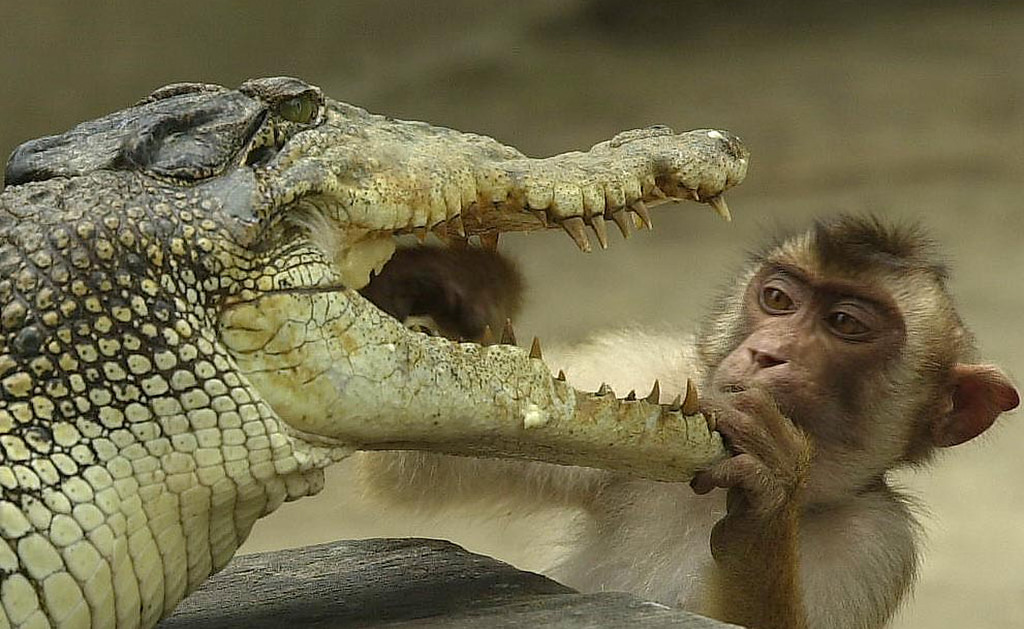
- The Monkey and the Crocodile jatakas are stories about a stupid crocodile that gets tricked, on multiple occasions, by a monkey that he is trying to eat. First, the monkey convinces the crocodile that he keeps his heart in a tree and gets away. The second time the crocodile pretends to be a rock, but the monkey sees through the ruse and gets away again.
- In both of the stories the monkey lives on the side of a river. In the middle of the river is an island full of lush fruit trees. The monkey wants to get to those trees and the crocodile attempts to use that desire against him. Lucky for the monkey, the crocodile is deeply stupid.
- My question, when reading these jatakas, is if the island in the middle of the river is so full of fruit to eat, why does the monkey insist on living on the riverbank? Why not move to where the food is? He is constantly risking his life to go back and forth when he could just live on the island, stay safe, and eat all that he wants all the time. The only reason he survives is because the crocodile is dumb and easily tricked. What would happen if the monkey came against a more intelligent crocodile?
- I would write a third jataka in which the stupid, young crocodile goes to his wily old uncle for help in catching the monkey. The monkey can just barely escape with his life and realize that the going back and forth from island to riverbank is no longer worth the risk.


Bibliography: The Jatakas Tales of India by Ellen Babbitt. Web Source.

Tuesday, October 17, 2017

Reading Notes: Savitri, Damayanti, Sati, and Uttara, Part B Sati's Story


(Wikipedia)

- Sati's story tells of her marriage to the god Siva. Her father, tasked with populating the universe, had married all of his daughters off to various gods. Sati was his youngest and his favorite. He was upset at her determination to marry Siva, as he was poor. However, Sati eventually got her way.
- Sati's father felt that Siva had insulted him, so he determined to return the insult. The ultimate result of his machinations was his daughter's death/suicide.
- Why are the people in these stories in such a hurry to die? The tiniest little hardship and they decide that the only possible course of actions is to kill themselves. The ridiculous levels of drama make middle school girls seem reasonable and emotionally balanced!
- That is the way this story should be told. Spoiled little rich girl and the boy from the wrong side of the tracks. Her father doesn't approve, and she can't handle it. He dares to insult her boyfriend. If she were to handle such a thing in a reasonable manner, she would be the heroine of the story. If she were to stand up to her father and live with her decision, she would be worthy of admiration. Instead, she takes the easy way out, or in my story, threatens to.


BibliographyNine Ideal Indian Women by Sunity Devee. Web Source.

Saturday, October 14, 2017

Reading Notes: Savitri, Damayanti, Sati, and Uttara, Part A Savitri's Story


Savitri (Wikimedia)

- Savitri is a princess. Her father had begged the goddess of the same name for an heir and she was the result. She was good and kind. She falls in love with Satyaban, the son of a blind and exiled king. They see each other across a river and fall in love at first sight.
- Savitri wants to marry Satyaban, but apparently his fate is to die within one year, so her father is against the union. Eventually, she is able to convince him that she could never be happy with anyone else and that she will never marry anyone else. Her father is forced to allow the marriage.
- Savitri goes off to live in poverty with her new husband and his parents for reasons that make absolutely no sense. Why can't Satyaban's parents just come live with them in the palace? He's blind and their both old. There is literally zero reason that it makes sense to keep them living in a hovel in the forest, with little to no food, when they could be living in comfort being well cared for. That's just dumb.
- The day of Satyaban's fated death comes and Savitri goes with him into the forest. He dies. Savitri follows Yom, the Lord of Death, after he comes to take Satyaban's body. She tricks him into bringing him back to life.
- This story is essentially saying that when love is great enough it can overcome death. That theme could be used to tell just about any story, but I think that it would make a good fairy tale.


BibliographyNine Ideal Indian Women by Sunity Devee. Web Source.

Friday, September 29, 2017

Reading Notes: Narayan's Mahabharata, Section C


Arjuna (Wikimedia)

- In the Mahabharata, the Pandava brothers have to spend the last year of their exile incognito. They cannot be recognized, and if they are, it will add twelve years to their exile. They choose to go under cover in Matsya in the court of King Virata.
- Arjuna chooses to pretend to be a eunuch named Brihannala and serve in the women's quarters. He does this in order to wear bracelets that will cover the scars on his arms from his bow and to fulfill the curse of Urvashi that was made in Indra's palace.
- Urvashi had been insulted by Arjuna's refusal to sleep with her, so she cursed him to be a eunuch who could only sing and dance with women. Indra requested that she confine the curse to a single year, with a year being the same amount of time that Arjuna had to stay incognito.
- Little is said within the Mahabharata about Arjuna's experiences in the women's quarters of the palace. He became a dance teacher to the princess Uttara, who he viewed as a daughter, and made friends with many of the women.
- It would be interesting to tell a story about Arjuna's experience with the women. What did he learn about women that he may not have known? Did he develop a deeper understanding about what their life is like or the different way in which they perceive the world? Did he develop a greater sense of empathy for women's lot in life in a patriarchal world?
- The story could be told of any man who is put in a similar situation and the deeper understanding that comes from living in the world of the other gender.


BibliographyMahabharata by Narayan. Web Source.

Friday, September 22, 2017

Reading Notes: Narayan's Mahabharata, Section B


Disrobing of Draupadi (Wikimedia)

- After Yudhishthira loses all of the dice games to Sakuni, and has bet his brothers, himself, and their wife, Draupadi is dragged into the room by a Kaurava brother named Duhshasana. She resists due to the fact that it is her time of the month, and therefore cannot be around people. Also, she argues that since Yudhishthira had bet himself before betting her, that he no longer retained the right to use her as a wager. The Kauravas don't care, and proceed to humiliate and mock her.
- At one point, one of the Kauravas attempts to strip Draupadi's sari off of her. She prays for protection to Krishna. When the sari is ripped away, she remains clothed. No matter how much clothing that is pulled off of her, her original sari remains in place.
- I would like to tell the story of this incident from Draupadi's point of view. She expresses her thoughts several time, but what else is she thinking and feeling? When she was originally accosted, and dragged off by her hair, what was running through her mind? What does she think about how Krishna chooses to answer her prayer? What is she thinking about the reactions of the Pandava brothers to her predicament? What expressions does she see on their faces? All of this would be interesting to determine how she is perceiving the events, and how she expects it all to end.


BibliographyMahabharata by Narayan. Web Source.

Reading Notes: Narayan's Mahabharata, Section A


(Wikipedia)

- While reading the Mahabharata, I felt that there wasn't a good enough reason for Duryodhana and his brothers to hate the Pandava brothers so much. They are cousins, they were raised together, and the Pandava's aren't particularly cruel or lacking in virtue. The story states in various places that the Pandavas play tricks on their cousins, that the cousins are jealous of the abilities of the Pandavas, and that the Kauravas are the incarnation of pure evil. The tricks aren't reason enough for the overwhelming hatred and if jealousy alone is enough to make you murder your own cousins, then you have to be very bad people. However, there is no support for the claim that the Kauravas are evil. How and why are they evil? Their heritage and family was good, so where exactly did this evil come from? There is no reasonable explanation for it.
- Since the idea of the Kauravas being evil just to be evil doesn't have any supporting evidence, then the best possible explanation is that the "tricks" that the Pandavas played on their cousin were far more harsh and unkind than simple children's tricks would imply. Another possibility is that Duryodhana believes that one of their "tricks" resulted in a tragedy that wasn't really caused by the prank that the Pandava's played. That would be a more logical explanation for the abiding hatred.
- A story about the boy's childhoods, detailing some of the tricks and the trick that had the supposed tragic ending would flesh out the conflict between the two sets of brothers.


Bibliography: Mahabharata by Narayan. Web Source.

Friday, September 15, 2017

Reading Notes: Sita, Promila, and Shakuntala, Part B Promila's Story


(Wikimedia)

- I found Promila's story to be particularly disturbing. I understood the context, and that her suicide was culturally acceptable, and shouldn't be judged by modern mores. However, I couldn't help doing so. Therefore, I decided to embrace that, and use it to tell my story.
- Promila felt as though she had nothing to live for after Indrajit died, he was literally her entire world. That was treated as normal, and even the way it should be in the story. It supposedly illustrated the depth of the love and loyalty that she felt towards her husband. However, in the time that has passed since the writing of the Ramayana, we have discovered that isn't love and it isn't loyalty. It's dependency, and a complete absence of any sense of self.
- I'd like to write a variation of Promila's story, written from her point of view as though in a suicide note or diary entry. She might have been raised in a very religious culture, which religion is irrelevant, but one that teaches a woman's place as being only an extension of her husband. Her note could detail that her suicide is considered normal, and that she does feel she has to do it, because she is no one without him. However, I also think that she should point out how much she regrets that fact. At the end, she is realizing that never getting a chance to understand who she is as a person, or even knowing that being her own person was a possibility, is a great crime committed against her.


BibliographyNine Ideal Indian Women by Sunity Devee. Web Source.

Reading Notes: Sita, Promila, and Shakuntala, Part A Sita's Story


(Wikimedia)
- In this version of the Ramayana, events are told more from Sita's point of view, and with her in the role as the primary protagonist. I like this version, because she does not exist simply as a catalyst for events, but as a more fully fleshed out individual.
- The end, with Sita being exiled was incredibly sad, and it was not what she deserved after all of her suffering, and the loyalty and virtue that she displayed. I would like to retell the story without those events happening.
- The idea that Rama cannot allow Sita to remain, because of the questions that the inhabitants of the city have about her virtue is ridiculous. Rama feels that it is his duty, but he also has a duty as a husband, and as a human being. How can it ever be right to punish someone that did nothing wrong, and in fact did everything right?
- I would tell the story with Rama getting angry at the accusations being made about his wife. He should put the gossipers in their place. If they believe that he is the rightful king and that he is wise, then the people should trust his judgement. He should tell the people that if they do not trust his judgement in regard to Sita, then they do not trust his judgement at all. And, if they do not trust it at all, then he cannot be king and lead them. Therefore, either they shut up, or he steps down.


Bibliography: Nine Ideal Indian Women by Sunity Devee. Web Source.

Friday, September 8, 2017

Reading Notes: Narayan's Ramayana, Section D

Hanuman (Pixabay)
- There was not one particular story chunk that stood out to me that I would like to retell. More than anything, I wanted to rewrite the entire thing and fix what I saw as extreme inconsistencies. I absolutely love the story. It's a great tale and I can see why it has stood the test of time. However, as a modern reader, one who is somewhat well versed in the literary and narrative principles that have evolved in the many years since the first telling of the Ramayana, I can't help but see things that I want to 'fix' so that they conform to my ideas of a good story/narrative.
- The Ramayana in general, and section D in particular, is a continuous episode of deus ex machina on crack. The army is trying to figure out a way to cross the water and get to Lanka, conveniently enough it just now comes out that Hanuman had all of these powers that he didn't know about. Rama needs to get back to Ayodhya within a day all of a sudden, oh look at this Pushpak Vimana that has just conveniently been lying around, but was never mentioned before. Rama is weirdly, and out of character, questioning Sita's honor, well I'm sure a fire god will show up to fix that problem. I modern storytelling, a deus ex machina style solution is to be avoided at (almost) any cost. In the Ramayana, it seems as thought problems crop up solely for the excuse to introduce one. Logically, I understand that the divine is a major purpose of the story, so of course any and all opportunity to present it would be welcome. But, I still want to fix it.
- The other irk is what I see as an inconsistency. Throughout the Ramayana, Rama has been referenced as an incarnation of Vishnu. Then, during the battle, Ravana thinks that he couldn't possibly be Vishnu, because Ravana would be protected against him. After the battle is won, Rama is told that he is, in fact, not Vishnu but the Supreme God, of which Vishnu is only a piece. Then, later, he's Vishnu again.


BibliographyRamayana by Narayan. Web Source.

Reading Notes: Narayan's Ramayana, Section C

(Desktopnexus)
- At one point in the Ramayana, Hanuman and his troop of monkeys end up lost and trapped in a dark cave. They eventually find a beautiful city that's almost entirely empty, except for one woman. Not much information is given about the woman, only that she had been a goddess, and due to a mistake, had been condemned to live in this underground city, alone.
- Who was she? What did she do that precipitated her exile to this empty, underground city? Did she build the city? If not, who did? Just enough information is given to raise interest, but not enough to tell a story. This would be an interesting story to tell, or to create a variation of.
- There are many ways that this story could be told. It could be recounted within the cultural/time framework of the Ramayana, using Indian myths to try and piece together an idea of who this woman might be. However, I think it would be interesting to tell it as a more contemporary story, without an obvious cultural ID.
- I think that I would approach this story as a fantasy. A woman with some magical powers accidentally kills the person that she is bound to protect. In shame, she runs away and ends up in an underground abandoned city, with no idea how to escape. As she explores the city, she discovers information about the builders and former residence. She tries to piece together information about these previously unknown people, and what happened to them.
- It would even be possible to include an allusion to Hanuman and the monkeys, by including a group of sentient monkeys living in the caves. They could be descended from the pets of the original cave builders/residents.


BibliographyRamayana by Narayan. Web Source.